

Some hard problems remain hard because the cost of solving them is too high to act on. Others remain hard because no one can agree on what leaving them unsolved is costing. Carbon has been the second kind for most of the last two decades, which is why it has largely been treated as a compliance obligation rather than a market position. The argument has long been about the number. That argument now has a peer‑reviewed anchor. The argument becomes about who will find the market position.
A Defining Moment in Time
There is a moment, in any hard problem, when the cost of solving it structurally drops below the cost of leaving it unsolved. That moment can be calculated, not guessed. The cost of the solution falls as technology deflates and verification gets cheaper. The cost of the status quo rises as the problem compounds and institutional alternatives exit. Those are the two curves: the falling cost of solving and the rising cost of leaving it unsolved. Both curves are moving. The crossing is the Crossover Point, and it arrives earlier than a static comparison would suggest, because both curves are in motion at the same time.
For most of the last two decades, carbon could not be read this way. The cost of the status quo, what the global system was actually paying to leave emissions unpriced, was a contested number. Estimates of the social cost of carbon ranged so widely, and rested on so many disputed assumptions, that no finance minister, no procurement officer, and no corporate board could put a defensible figure on what the problem was costing. That uncertainty was the real chokepoint. It kept the entire carbon debate stuck in an argument about whether the number was real, rather than what the number unlocked.
In March 2026, Marshall Burke and colleagues at Stanford resolved that argument. The technical details are dense, yet the headline is straight-forward. A peer‑reviewed paper in Nature produced the most rigorous quantification to date: a central estimate of the social cost of approximately US$1,013 per tonne of CO₂ under conservative assumptions (2% discount rate, no impacts past the year 2100), rising to US$3,448 under continued post‑2100 growth effects at the same 2% discount rate, and to US$7,822 under Ramsey discounting through to the year 2300 (Burke et al., 2026, Extended Data Table 2). That central figure is an order of magnitude higher than the bottom‑up estimates currently used by the US Federal Government, and well above the prices in any operational carbon market on earth.
And the authors are explicit that these figures are conservative. They measure GDP loss only. They do not capture biodiversity collapse, cultural displacement, loss of ancestral homelands, sea level rise, or the full weight of extreme weather events. The paper itself states that “our damage estimates will understate the total damages associated with historical and future emissions, perhaps substantially.” Speaking to reporters at publication, co-author Noah Diffenbaugh put it plainly:
“We haven’t accounted for impacts that aren’t captured in GDP, such as loss of biodiversity and cultural homeland, and our approach also underweights some sources of climate impacts such as sea level rise and some types of extreme events. This makes our estimates conservative.”
The central figure is also, in the authors’ own framing, “much larger than recent bottom-up estimates produced by the US Federal Government” - roughly five times the EPA’s most recent figure under comparable assumptions. The unpriced cost is higher. It just hasn’t been quantified yet.
The second curve now has a peer-reviewed anchor.
Pricing the Status Quo
The Burke number does something specific. It is not a bill you can hand to a single client or customer. An airline cannot tell a passenger, “we are adding a charge because your flight’s emissions cost US$1,013 per tonne,” because the damages from that tonne are shared across the whole planet and over many years, not just borne by the person buying the ticket. The same is true everywhere: the real cost of carbon is distributed across populations, ecosystems, and timescales no single buyer sees on their own balance sheet.
What the number does is anchor a trajectory that was previously a directional argument. The Burke figure is an anchor price and a liability ceiling that exerts upward pressure on every adjacent cost in the carbon stack over time.
Every cost currently rising - mandatory climate disclosure compliance under regimes like Australia’s AASB S2, the EU Corporate Sustainability Reporting Directive, California’s SB 253, rising landfill levies, insurance premium differentials on climate-exposed assets, Scope 3 push-down from major corporate buyers, ESG claim legal exposure - is rising because the underlying systemic cost is an order of magnitude higher than anyone previously priced it. Burke et al. have measured the pressure that is pushing these client-level costs up.
A few concrete figures from the paper illustrate what this trajectory looks like when translated into specific actors.
One tonne of CO₂ emitted in 1990 caused approximately US$180 in global damages by 2020. That same tonne will cause an additional US$1,840 through to 2100. The historical damage was less than 10% of the total debt.
US emissions since 1990 have caused approximately US$10.2 trillion in cumulative global damages by 2020, with about 30% (US$2.97 trillion) felt inside the US itself and 14% (US$1.39 trillion) in the European Union.
Aramco’s 1988 to 2015 emissions alone represent an estimated US$3 trillion in cumulative global damages realised by 2020 - roughly eight years of company revenue - rising more than 20-fold to US$64 trillion by the end of the century if those emissions remain in the atmosphere (Burke et al., 2026).
The distributional picture is clear. Per-capita emissions data from global inequality research (Chancel et al., World Inequality Lab) places the top 0.1% of global emitters at over 290 tonnes of CO₂ per person per year; the poorest 50% at roughly 0.7 tonnes. Applying the Burke central social cost to those figures produces approximately US$294,000 in annual damages caused per person in the top 0.1%, against roughly US$710 per person in the poorest 50%. A 400-to-1 ratio, between the populations that contribute most and the populations that bear the consequences most heavily.
As mentioned above, these numbers are conservative. They are the priced GDP component only. The full cost is larger, and not yet reducible to a single figure.
The Cost of Solving is Collapsing
While the second curve was being priced, the first curve was falling. Three cost categories - monitoring, verification, and payment - historically made carbon markets expensive to build and easy to contest. All three are now approaching marginal costs that round to zero.
Monitoring is now satellite-native. Commercial archived imagery now costs in the range of US$10–20 per square kilometre, with fresh tasking typically in the range of US$20–40 per square kilometre for sub‑metre resolution (Planet, Maxar, Airbus 2025 price tiers). A decade ago, that capability sat exclusively with institutional field missions and cost orders of magnitude more.
Verification is now cognitively cheap. Frontier‑equivalent inference costs have fallen in the range of 90–95% between early 2024 and early 2026, across multiple benchmark series (Epoch AI and Artificial Analysis tracking). The cognitive layer required to process and verify disclosure data at scale now costs almost nothing at the margin. Digital identity registration has fallen from over US$20 per person to under US$1 per person at national scale (World Bank ID4D benchmarks), making it possible to attach verified emissions data to specific transactions, assets, and producers.
Payment has scaled further than most observers have registered. India’s UPI processed 22.64 billion transactions in March 2026, a record high and a 24% year-on-year increase in volume. Brazil’s Pix has onboarded 93% of the adult population and now processes more daily transactions than Visa and Mastercard combined. Kenya, Peru, Namibia, and Trinidad and Tobago are running on licensed derivatives of the same infrastructure. Outcome-linked capital can now be routed to specific populations at costs the old architecture could not match. Burke and colleagues themselves identify this as an open avenue, noting that “well-developed opportunities for transfer payments also exist outside the international system, such as bilateral, low-cost transfer payments to the mobile phones of low-income households in developing countries.”
Monitoring, verification, and payment. Three pillars. All three have crossed the threshold where cost is no longer the binding constraint.
How to Calculate a Market Position in Carbon
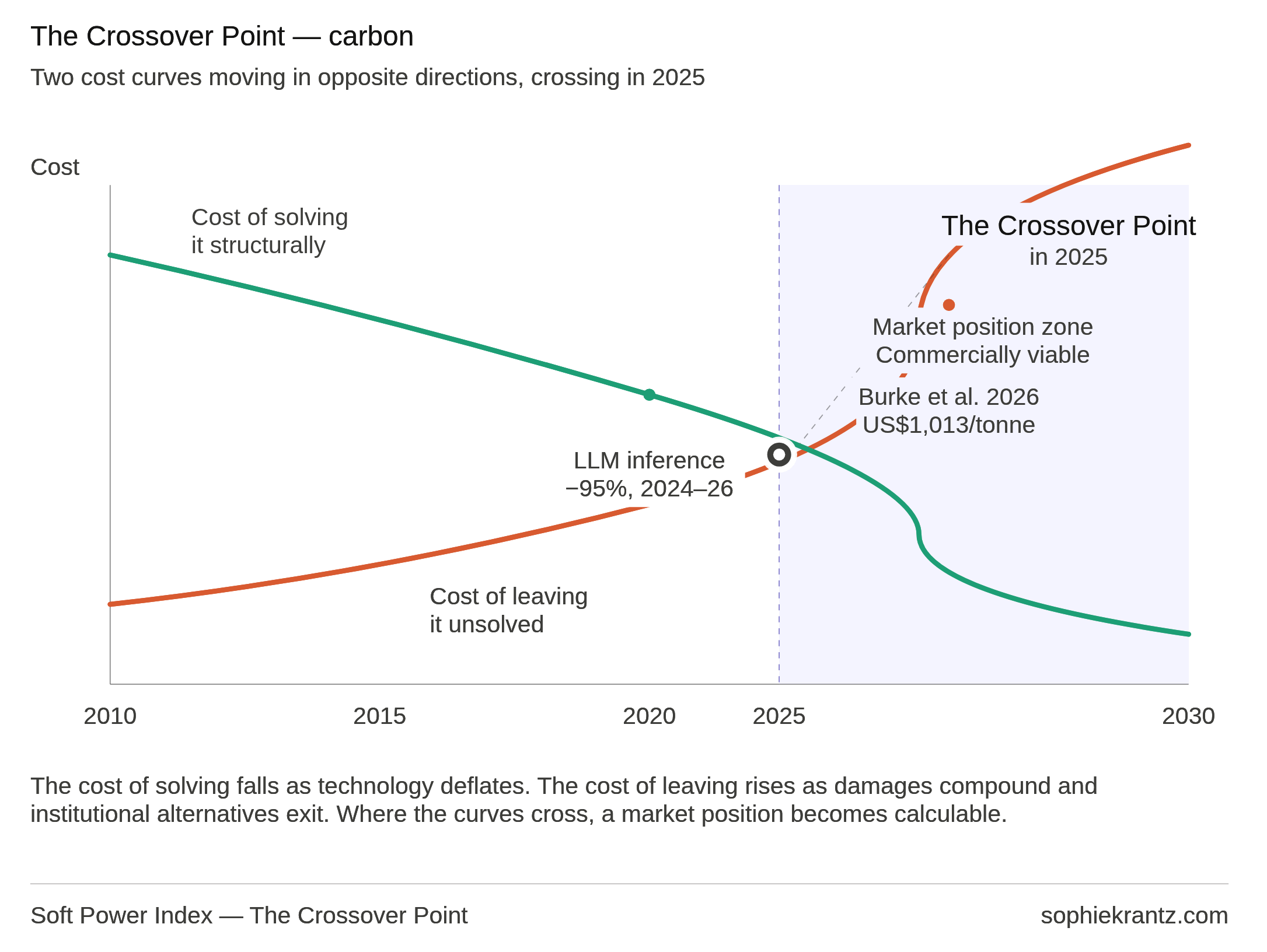
Put both curves in the same frame and a specific claim becomes possible for the first time.
The cost of the status quo in carbon is priced at roughly US$1,013 per tonne globally, rising, and conservative. The cost of verifying, monitoring, and contracting against a tonne has fallen to a level where the architecture to deliver a priced, verified unit – one tonne verified and reported, one asset tracked with full material provenance, one disclosure‑ready procurement decision – is commercially deliverable at a cost well below what the system is already absorbing.
Putting a number on the second curve – the cost of leaving carbon unsolved – is what makes it possible to see when solving becomes cheaper than not solving, and to treat that gap as a market opportunity. When it is cheaper to solve, you can create offers that finance ministers, procurement officers, and corporate boards will listen to – offers that can be written into real contracts.
That is a Crossover Point. The Burke paper, published in March 2026, is what makes it calculable. The framework’s own contribution, in the authors’ words, is that the approach “aligns the financial accounting framework of L&D with the existing SC‑CO₂ framework.” That alignment is what turns a contested number into something legible to courts, disclosure regimes, and insurance underwriters – and it is what Diffenbaugh himself signals when he notes that the work clarifies “the cost‑benefit analysis of potential solutions.” The number is no longer just a damages estimate. It is a basis for calculating whether a given response is worth doing. And because the Outcome Unit – one verified tonne – is the same across every sector where carbon is embedded, the addressable market sits beyond one industry. It is the full global economy, priced at the full social cost of emissions, rising on a measured trajectory.
For the first time, a market position in carbon can be calculated. The number is large, the number is global, and the number is conservative.
Calculating the Market is the First Step, Not the Solution
An important qualification: a calculable market position is not the same as a solved problem. What the calculation establishes is that it is now commercially viable for the market to solve the problem, at a cost below what the system is already paying to leave it unsolved. That is a necessary condition. It is not a sufficient one.
Carbon remains a hard problem, and it is hard for specific reasons. It crosses borders, which means no single jurisdiction can price or enforce it comprehensively. It compounds over timescales longer than political cycles and corporate strategy horizons. It distributes damage asymmetrically, hitting populations that did not cause it and have little capacity to absorb it. It requires coordination across actors who have no prior history of coordinating and limited reason to trust each other. And it sits across public and private boundaries in a way that makes both pure-market and pure-state solutions structurally incomplete.
These are coordination problems, legitimacy problems, and trust problems. They are the class of problem that mandates, money, and market failures have a long history of failing to solve.
The open question, now that the market can be calculated, is what kind of actor will occupy the position.
What Soft Power Has Already Solved
The useful signal sits in adjacent spaces where the same class of problem is hard, cross‑border, coordination heavy, and trust dependent, and has already been crossed. Three cases are relevant references, because each demonstrates a specific dimension of what carbon now requires.
Pricing the Outcome Unit: Living Goods. Child survival in sub-Saharan Africa was, for decades, the archetypal case of a hard problem that money and mandates could not fix. Billions of dollars in donor funding, state health system budgets, and multilateral programme delivery produced activity without accountability. Inputs were tracked. Outcomes were not.
Living Goods changed the calculation. A 2021 randomised controlled trial (RCT) covering 4,500 community health workers (CHW) serving 3.6 million people in Uganda established that a compensated, digitally supervised CHW architecture produced a 30% reduction in under-five mortality and a 27% reduction in infant mortality. The Kenyan government moved the model from externally funded project to county-contracted public service. The shift was not driven by mandate. It was driven by arithmetic. The market opened because the Outcome Unit was priceable and the ratio was defensible.
Carbon has just had its RCT moment. Burke et al. have priced the Outcome Unit at an integrity standard a government buyer can defend.
Verification without intermediaries: Hala Systems. For decades, accountability for wartime atrocities depended on institutional chains of custody: human observers, NGO field missions, UN verification, state-mandated tribunals. Each required physical access, institutional backing, and months of verification before evidence could be submitted. The chokepoint was physical and institutional.
Hala Systems dissolved that chokepoint by replacing the chain of custody with a chain of provenance secured by code. Cryptographic verification removed the need for the observer. The question shifted from “who collected this evidence and can we trust them?” to “has this data been altered since it was recorded?” A court can answer the second question without an institutional intermediary. The world’s first ICC Article 15 dossier featuring cryptographically secured evidence was submitted through this architecture. The evidentiary standard is now mathematical rather than reputational.
Carbon faces the same verification problem at enormous scale. Every tonne of embodied carbon, every verified avoided emission, every traded credit requires a chain of provenance that currently depends on institutional trust, and currently collapses under sustained scrutiny. The architecture that proved itself in conflict zones, where every data point is actively contested, is precisely the architecture that carbon verification now requires.
Coordination against asymmetric harm: Tostan. For decades, international attempts to address female genital cutting and child marriage in West and East Africa relied on legal bans, state enforcement, and awareness campaigns. Each required either state capacity to enforce compliance or individual conviction to change behaviour. Neither addressed the actual problem: a family that abandoned a harmful norm alone faced prohibitive social and economic consequences that law and information could not protect against.
Tostan demonstrated that the problem was solvable, but not by hard power. It was a coordination problem. When a critical mass of community members could publicly commit together, the social equilibrium shifted and the new norm became the lower-cost choice. Over 10,000 communities across eight countries have now publicly declared abandonment. A UNICEF evaluation confirmed the change held 8 to 10 years after the intervention ended, with no further programming. The Government of Senegal integrated the model into national strategy. Ten UN agencies adopted it as a reference framework.
Carbon redistribution is the same class of problem. The payment rails now exist. UPI, Pix, and their licensed derivatives can route low-cost transfers to mobile phones of low-income households. The measurement science now exists. What is missing is the coordination layer that routes priced outcome payments from the populations causing damage to the populations bearing it. That coordination layer cannot be built by the institutions that failed to deliver climate finance under the old architecture, because they still operate under the constraints that made them fail.
It has to be built by actors who can hold credibility across jurisdictions, operate without institutional sponsorship, and verify outcomes in a way that capital can contract against. That is precisely the class of actor that has already solved the adjacent problems.
What This Means for Capital Allocation
The carbon space has just completed a transition that took child survival in Africa two decades, conflict evidence a decade, and norm change in West Africa twenty years. The Outcome Unit is priceable. The Crossover Point is documented. The payment infrastructure is operational. The verification architecture has already been battle-tested in a harder environment.
The implication for capital is more pointed than the general argument suggests. The Burke number is not a price target. The investable thesis is not “buy credits until they converge on US$1,013.” The investable thesis is that the gap between market price and true damage will be closed by litigation, disclosure, and insurance repricing, not by voluntary market convergence. That changes where capital should sit.
Even on conservative assumptions, the order of magnitude is clear. For example: human activities released roughly 53 gigatonnes of CO₂-equivalent in 2024 (all greenhouse gases on a CO₂e basis, per the UNEP Emissions Gap Report). If just 5% of that annual flow ends up under contracts, disclosures, or insurance models that reference Burke-level pricing in some form, that is a notional US$2.7 trillion of damage per year at US$1,013 per tonne. A verification-native platform that intermediates even 0.5% of that value as fees would be looking at an annual revenue line on the order of US$13 billion. The exact numbers will move; the order of magnitude will not. These are order‑of‑magnitude illustrations, not forecasts or investment advice.
That, in turn, clarifies where in the stack capital should sit. Not in the commodity layer: offset portfolios and credit generation assets in thin premium markets. Yes in the intelligence layer: MRV infrastructure, provenance systems, disclosure software, and coordination rails - the architecture that makes the gap enforceable.
And the timing signal is not the carbon price curve. It is the disclosure calendar. AASB S2 Group 1 reports are being filed now; Group 2 reporting begins 1 July 2026. California SB 253’s first Scope 1 and 2 reports are due 10 August 2026. Those venues - courts, disclosure footnotes, and insurance underwriting models - are where the Burke number becomes a financial reality. The investment horizon that matters is 2026 to 2028, not 2030 and beyond.
Beyond Carbon
The calculation that opened the carbon position is not specific to carbon. It is the same calculation that opens any hard problem: define the Outcome Unit, price the cost of the status quo, measure the cost of structural solving, and identify the point where one drops below the other.
Carbon is the largest case currently calculable. It is not the only one. The Soft Power Index has mapped twelve hard problem fields where the Crossover Point has been reached or is approaching - among them antimicrobial resistance, where one institutional payment chokepoint suppressed a 28:1 return for thirty years until the NHS subscription model changed the logic in 2024; the learning crisis, where verified literacy outcomes can now be priced at US$12 per child; and access to justice, where 5 billion people are excluded from basic legal services and digital paralegal networks are starting to close the gap.
Each is calculable. Each has an Outcome Unit, a Crossover Point, and a market position waiting to be held.
Who Moves First
In carbon, cost of the hard problem can be calculated. The second curve has a peer‑reviewed anchor. The market position is defensible. The first step – calculating that the market exists – is done.
If you are a corporate, investor, builder, or operator, the move is the same: compete beyond the commodity layer of offsets and credits. Build, buy, or back the infrastructure that lets governments and companies prove, in contracts and audits, that they are structurally reducing their future carbon liability - the MRV, provenance, disclosure, and coordination systems that make Burke‑level pricing usable. That is where growing demand for solutions that reduce disclosure, legal, and insurance costs will meet a constrained supply of credible options.
What happens next depends on who moves while the position is still open. Hard problems are where the next generation of defensible market positions will be built. That is where leaders seeking positive‑sum outcomes will focus. The work is to find the market in the mission.
Further Reading and Sources:
Burke, M., Zahid, M., Diffenbaugh, N. S. & Hsiang, S. “Quantifying climate loss and damage consistent with a social cost of carbon.” Nature 651, 959–966 (2026). DOI: 10.1038/s41586-026-10272-6. SC-CO₂ scenarios and ranges drawn from Extended Data Table 2. Direct quotations from the paper text and from Extended Data discussion.
Diffenbaugh quotations from press materials accompanying publication, 25 March 2026 (syndicated via Phys.org and Stanford research communications).
Chancel, L. et al. World Inequality Report (World Inequality Lab), per-capita emissions data for top 0.1% and bottom 50%.
Living Goods second randomised controlled trial (Uganda, published 2021): 4,500 CHWs, 3.6M people, 30% under-five mortality reduction, 27% infant mortality reduction.
Hala Systems: world’s first ICC Article 15 war crime dossier featuring cryptographically secured evidence.
Tostan: UNICEF long-term evaluation; Government of Senegal national integration; ten UN agencies adopted as reference framework.
Technology and payments data: NPCI (UPI March 2026 volumes: 22.64 billion transactions); Banco Central do Brasil (Pix adoption); commercial satellite imagery pricing (Planet, Maxar, Airbus archives); LLM inference pricing benchmarks (2024–2026); World Bank ID4D digital identity benchmarks.
UNEP Emissions Gap Report 2024 for 53 GtCO₂e annual emissions baseline.
Krantz, S. Soft Power Brief Q1 2026: Hard Problems Become Market Positions. Full profiles of five organisations across financial inclusion, conflict verification, smallholder agriculture, community health, and collective norm change; scoring methodology; the three calculations framework. softpowerindex.lovable.app.
Calculating the Second Curve

Most people working on hard problems, the kind affecting hundreds of millions of people across health, education, financial access, and climate, have calculated the size of the market. The number of people affected, the scale of unmet need, or the Total Addressable Market (TAM) if this were a venture pitch. That calculation is usually large and usually …
Latent, Not Lost
Hard power, deployed through money and mandate, is no longer enough to solve the world’s most challenging problems. Health, education, climate, financial inequality, and justice remain the largest underserved market opportunities of our time. Institutional players are retreating. Building a market position in these spaces means drawing on the capital, t…