

Hard problems don’t stay hard because they’re unsolvable. They stay hard because the leaders working on them are increasingly making decisions calibrated to a world that no longer exists. And because the people who could lead aren’t - often they believe the barriers are too high.
The problems this series examines affect hundreds of millions or billions of people, cross borders, and sit inside systems - laws, markets, infrastructure, and norms - that no single institution controls and no single actor can fix alone. That is what we mean by hard.
The cost assumptions were formed, for example, when satellite imagery required government contracts and physical surveys cost hundreds of dollars per household. The timeline expectations were formed when reaching a billion people required a decade of institutional negotiation. The dependency assumptions were formed when the only route to scale was via multilateral agencies, bilateral funders, and the slow physics of government procurement cycles.
Those assumptions were reasonable once. They are now actively misleading.
This series introduces three calculations that turn hard problem rhetoric into concrete numbers; numbers that de‑risk working on hard problems and clarify where to put scarce time, capital, and attention.
The Conditions Have Changed
The tools available to a leader working on a hard problem today are not incrementally better than the tools available in 2010. They are categorically different in cost, reach, and speed.
Across sectors, the unit economics of key enabling technologies have collapsed:
Global average costs for digital identity verification checks are now around US$0.20 and are projected to fall further as volumes scale.
High‑resolution satellite imagery and remote sensing have driven the per‑parcel cost of land measurement far below that of legacy, labour‑intensive field surveys, making parcel‑level mapping technically and financially feasible at national scale.
India’s Unified Payments Interface (UPI) processed about 172 billion transactions in 2024 - over 14 billion per month - illustrating the scale of low‑cost, real‑time digital payments.
Brazil’s instant payment system Pix has reached more than 170 million users, roughly 93 percent of the country’s adult population, without relying on dense physical branch networks.
AI‑powered tools for legal and compliance workflows are already delivering large time and cost savings, suggesting that specialised land‑tenure documentation can similarly see order‑of‑magnitude reductions in per‑case costs. For example, AI document intelligence platforms automate review, extraction, and drafting across complex legal documents.
In agriculture, emerging AI agronomy platforms use data‑driven recommendations to scale soil analysis, crop planning, and pest detection across many farms, sharply lowering the marginal cost of advice once the system is deployed.
These demonstrate changed conditions. The hard problems are still hard. The people still waiting for socioeconomic, environmental, health, and education solutions are still waiting. What has changed is the set of tools available to the leaders who decide to act - and therefore what we should expect of those leaders, and of ourselves.
The change in conditions is about what existing leaders can do. And it is about who can lead.
For most of the last half-century, working seriously on hard problems required a specific kind of entry ticket: institutional affiliation, large funding bases, decades of relationship-building with the gatekeepers who controlled access to beneficiaries, governments, and legitimacy. The problems were large enough that only large actors could reach them. Which meant the universe of people who could credibly act was, by definition, small.
That constraint is dissolving. The same cost curves that have made high‑resolution satellite and GPS-based mapping vastly cheaper than traditional household field surveys now make them accessible to a team of twenty as readily as to a multilateral agency. The same digital identity rails that have pushed average per‑person onboarding costs down to well under a dollar do not discriminate between an established NGO and a leader who incorporated last year. The infrastructure that used to require institutional scale to access is becoming, in domain after domain, a public good. Which means the question of who is structurally positioned to move a hard problem is no longer answered by looking at who has the biggest budget or the longest track record. It is answered by looking at who has run the three calculations - and who is willing to act on what they find.
There is a third implication that follows from all of this: some leaders who run the three calculations will find that the structural agency available to them has already outrun the ambition they’ve been willing to declare. That the limiting factor is no longer infrastructure, capital, or institutional permission. That what they’ve been calling ‘being realistic’ is just staying calibrated to an older world.
The three calculations have a side effect. On the one hand, they make bolder goals possible. On the other hand, they make smaller goals harder to justify.
Not more ambition. More precision. Specifically: three calculations that the most effective organisations working on hard problems are already running, and that most leaders have not yet made.
This series applies the three calculations to twelve of the world’s hardest problems. This piece explains what the calculations are, where they come from, and why all three are necessary before any of them is sufficient.
The First Calculation: The Crossover Point
In the 1930s, Theodore Wright was studying the economics of aircraft manufacturing when he noticed something that would later be generalised across almost every industry in the world. Every time cumulative production of a given technology doubled, the cost fell by a predictable percentage. Not randomly. Not occasionally. Reliably, across industries, across decades, across technologies with nothing in common except that humans were making more of them and getting better at it.
Wright’s Law is now one of the most empirically robust findings in the economics of technology and cost decline, as shown in this overview of Wright’s Law and learning curves. It has been validated in solar panels, semiconductors, batteries, DNA sequencing, and dozens of other technologies. The implication for hard problems is specific and underused: the cost of the tools needed to address most hard problems is falling on a predictable curve. Which means the moment at which a structural solution becomes cheaper than the system’s cost of doing nothing is calculable - not guessed at, not hoped for, but calculated.
That moment is the Crossover Point.
The Crossover Point asks one question: when does a structural solution become cheaper than the system’s cost of doing nothing - and what will it take to bring your model to that point faster?
Before it, a leader working on a hard problem is competing against inertia with more expensive tools than the incumbent. Every partnership comes with conditions. Every funding relationship carries compromise risk. The institutional gatekeepers hold the leverage because they control the only viable route to scale.
After it, inertia works in the other direction. The institution’s cheapest option is now to adopt what the leader built - because it’s cheaper than continuing to do nothing. This is also when the model becomes commercially viable - not as a byproduct of mission, but structurally. After the Crossover Point, a leader is not competing against a better-funded incumbent. They are operating with a lower cost base than the institution whose inertia they just outran.
The cost of inaction is not zero. It is large and measurable. We can see it in three domains that are unusually well quantified:
Every US$1 invested in deworming returns an estimated US$169 in productivity and long-term earnings.
Rigorous analyses suggest every US$1 invested in family planning can generate on the order of US$7 in direct public-sector savings in high-income settings, and as much as US$100+ in wider social and economic benefits in low- and middle-income countries.
Best-available analyses suggest that investing in agricultural research and development can return more than US$20–30 in benefits for every US$1 invested.
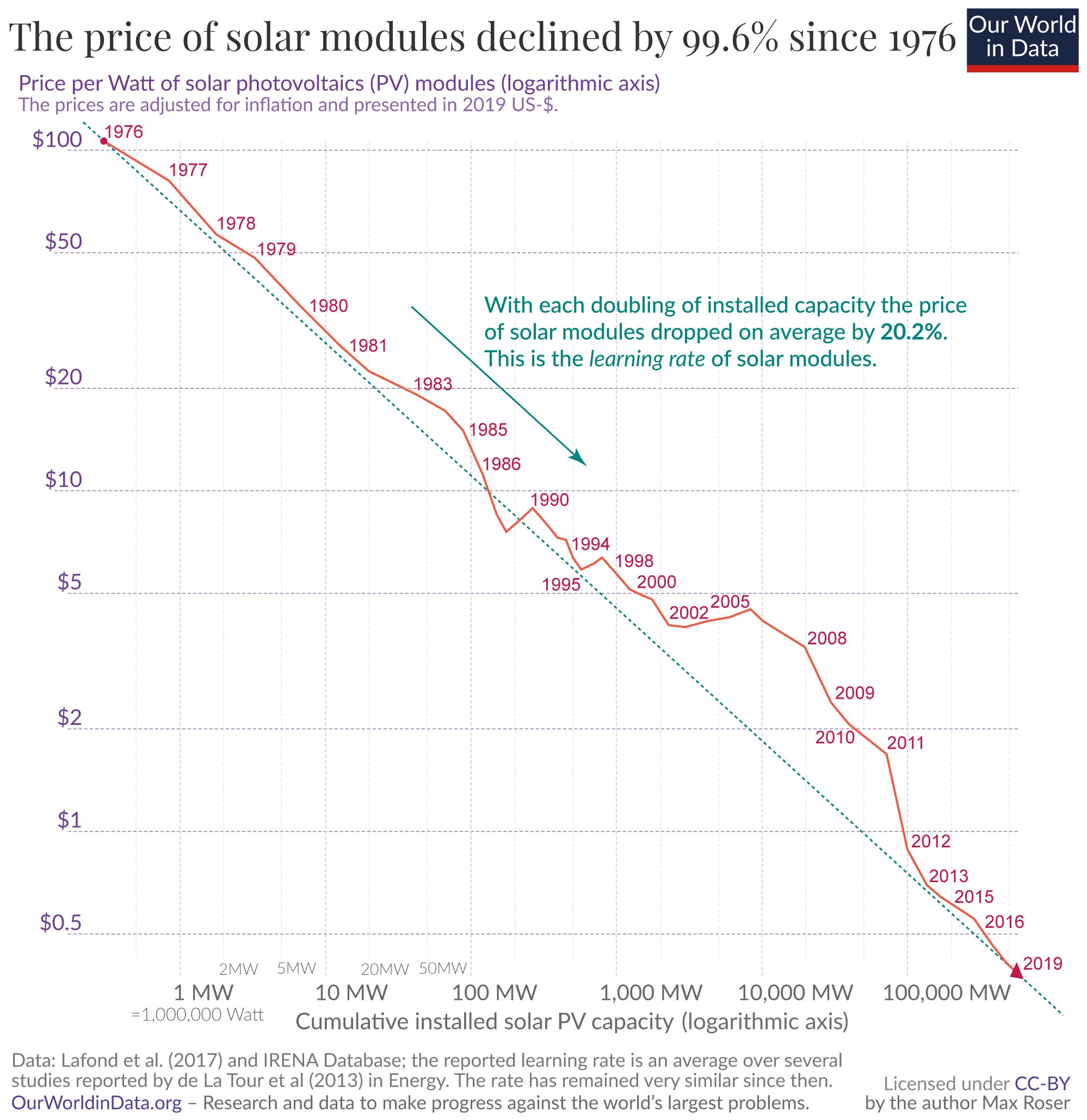
We can calculate the moment, yet the economics for a solution do not stop there. The calculation has a trajectory, not just a moment. Solution costs fall on a predictable curve as technologies scale. At the same time, the cost of institutional inaction compounds - more displacement absorbed, more productivity lost, more systemic fragility carried forward. Both curves are moving. Which means the crossing point arrives sooner than a static comparison suggests.
The cost of institutional inaction - in lost productivity, compounding health burden, and systemic fragility - is calculable in almost every hard problem domain.
Hard problems aren't waiting for more resources or more political will. They're waiting for leaders running a different set of calculations. When we run them, hard problems stop looking like moral obligations and start looking like market positions.
A leader who builds the model before the crossing occurs is not early. They are positioned. When institutions finally move - and they will, because inaction becomes more expensive than adoption - they will find the architecture already built by someone else.
In almost every domain, the Crossover Point exists, is calculable, and yet is rarely calculated first. It should be.
The Second Calculation: The Chokepoint Map
For decades, institutional intermediaries controlled the only viable path to scale: to beneficiaries, to funders, to governments, and to legitimacy. That control is eroding - in some places, it has already gone.
Digital public infrastructure shows what this looks like in practice:
India’s Unified Payments Interface (UPI) and Brazil’s Pix have made low‑cost, real‑time payments available at population scale on rails that no single institution owns.
Digital identity and eKYC have pushed per‑person onboarding costs down to well under a dollar in many markets.
Community members in countries like Ghana are using mobile and geospatial tools to help map land boundaries and feed data into formal systems.
AI‑assisted legal tools are expanding what paralegals and front‑line legal workers can do by automating routine tasks and freeing scarce central expertise for the edge cases.
Rather than being incremental improvements, they demonstrate what happens when essential infrastructure becomes a public good rather than a proprietary asset.
Every chokepoint a leader is still routing through is a point of leverage someone else holds over their mission. The organisations working most effectively on hard problems are the ones that mapped those chokepoints early - and either routed around them or built the infrastructure that made them irrelevant. That is not just operational efficiency. It is the recovery of agency. It is how an organisation earns the structural ability to say no to a bad partnership, decline a distorting grant, or hold a position under pressure without fearing the consequences.
The Chokepoint Map has four domains: People, Money, Data, and Legitimacy.
In each domain, the question is the same: who can still slow, veto, or tax your path from Outcome Unit* to scale? (*explained below)
The critical distinction within each domain is between structural chokepoints - those that exist because of law, physics, or irreducible constraint - and legacy chokepoints - those that exist because of habit, assumption, and the interests of actors who benefit from treating negotiable gates as permanent ones.
In almost every hard problem domain, at least one chokepoint treated as permanent five years ago is now negotiable. Finding it before incumbents consolidate around the new tools is a strategic advantage with a closing window. The Chokepoint Map is how you find it - and how you distinguish the gates worth routing around from the ones that are genuinely structural.
The Third Calculation: The Voltage Test
Economist John List identified what he called the voltage drop in his book The Voltage Effect: How to Make Good Ideas Great and Great Ideas Scale: the phenomenon by which a large share - often 50 to 90 percent - of programs that work in pilots fail at scale. This was not caused by bad ideas or insufficient funding. It was chef-dependency - models built around a founder’s presence, judgment, and relationships rather than replicable logic. When the founder moved on, the funding changed, or the political context shifted, the model lost its voltage. In addition to it stopping to work, it also started making compromising decisions on the way down - accepting distorting funding, narrowing its mandate, or drifting from its original purpose - because it had no structural alternative.
The Voltage Test asks one question: does your model work when you’re not in the room?
More specifically: does it work when the government changes, the funder pivots, and the founding team moves on? Most programs fail this test not because the idea is wrong but because the design was never asked to answer it. The founder’s presence was assumed. The funder’s continuity was assumed. The political moment was assumed. When those assumptions broke, the model broke with them.
The organisations that score highest in any serious assessment of hard problem impact have all solved this problem - though not all the same way.
Pratham’s Teaching at the Right Level works without its founders in the room and has been adapted and implemented by governments and partners across India, Africa, and beyond, reaching more than 80 million children.
Namati built the Grassroots Justice Network - now over 16,600 members from 175 countries - on a model designed from the outset to put the power of law in people’s hands rather than central offices.
Landesa works with governments to design and implement national land laws and programs that are field-tested, financially and politically feasible, and explicitly intended to function at scale without Landesa present in every community.
One Acre Fund uses a revolving loan structure in which farmer repayments are recycled into the following season, enabling the model to operate and grow through system design rather than founder oversight.
What made building voltage-proof models hard was time. Historically it took a decade of iteration to embed a model’s logic in systems rather than people. That constraint is dissolving. Agentic AI - systems that execute multi-step processes, adapt to local variation, and operate without constant human oversight - is more than a productivity tool. It is a scaling architecture. The Voltage Test is now answerable in the design phase, not the scaling phase. Leaders who ask ‘how does this work without me?’ before they ask ‘how do we grow?’ are building something structurally different from every previous generation of mission-driven organisation.
Why All Three Are Necessary
Each calculation is insufficient alone.
A leader who calculates the Crossover Point but hasn’t mapped the chokepoints will arrive at the right moment through the wrong route - dependent on institutional gatekeepers who will extract rent for access at exactly the moment the leader needs independence most.
A leader who maps the chokepoints but hasn’t run the Voltage Test will build something that works brilliantly in the pilot and collapses when they leave - because the model’s logic lived in their judgment rather than in replicable systems.
A leader who passes the Voltage Test but hasn’t calculated the Crossover Point will build something durable and permanently subscale - because the economic logic that would make it the rational choice for governments and commercial capital to adopt never got calculated, and the model stays dependent on philanthropic subsidy when it could have been self-funding.
Together, the three calculations produce something different from any one of them: a map of leverage. Not analysis of the problem - every domain has that. A map of when to move, how to move without permission, and what to build so that what you build holds.
The Map The Three Calculations Produce
The three calculations are not a checklist. They are three different lenses - economic, structural, and architectural - that produce different information. Their value compounds at the intersections.
We can picture them as three overlapping circles:
The Crossover Point and the Chokepoint Map together - without the Voltage Test - produce the Opportunity Window. You know when the economics work and you know the routes that don’t require institutional permission. You can see that a move is possible and viable. What you cannot yet see is whether what you build will hold when you step back. This is where most well-funded initiatives live: they found the right moment and got in through the right door, but the model depends on the founder’s continued presence to function. The window is real. The model won’t last.
The Chokepoint Map and the Voltage Test together - without the Crossover Point - produce the Durable but Subscale Model. You know how to move without institutional permission and you’ve built something that holds without you. The routes are clear and the architecture is sound. What you haven’t calculated is when the economics tip in your favour - so the model stays dependent on philanthropic subsidy rather than becoming the rational choice for governments and commercial capital to adopt. This is where many of the best mission-driven organisations live: genuinely independent, genuinely voltage-proof, permanently undercapitalised because the commercial case was never made.
The Crossover Point and the Voltage Test together - without the Chokepoint Map - produce the Stranded Asset. You know the economics work and you’ve built something durable. But you’re still routing through institutional gatekeepers to reach the people the problem affects. The model is real and the timing is right, but the route is controlled by someone else. This is where promising models get captured - absorbed by the institutions they were meant to route around, or forced into compromise partnerships because the permissionless alternatives were never mapped.
At the centre - all three calculations together - is the map of leverage itself. When to move. How to move without permission. What to build so that what you build holds. This is also where commercial viability and mission integrity stop being in tension. The Crossover Point tells you when the economics work. The Chokepoint Map tells you how to capture that value without routing it through extractive intermediaries. The Voltage Test tells you how to build something that compounds rather than depletes. Together they describe an organisation that doesn’t have to choose between surviving and doing what it said it would do.
Across twelve editions, this series will show where current real-world responses to each problem are stuck - which intersection they’re in, and what the missing calculation would change. The pattern that emerges is the argument.
The Outcome Unit
Beneath all three calculations is one prior requirement that most leaders working on hard problems have not met: the Outcome Unit.
The Outcome Unit is the atomic, binary, verifiable result:
Not ‘education’ - one child reading independently at the age they should be.
Not ‘land rights’ - one household with verified, digitally registered tenure.
Not ‘financial inclusion’ - one person with an active account used in the last 90 days.
Not ‘health access’ - one person who received the treatment the evidence says works, verified by independent data.
Without a precise Outcome Unit, the Crossover Point cannot be calculated - you cannot price what you cannot define. The Chokepoint Map cannot be completed - you cannot identify the route to the outcome if the outcome is a category rather than a result. The Voltage Test cannot be passed - you cannot embed replicable logic in systems if the logic depends on a founder’s judgment about what counts as success.
The Outcome Unit is not academic precision for its own sake. It is the foundation that makes agency real. A leader can only credibly say no - to a distorting grant, a compromising partnership, a mandate that would narrow the mission - if they can prove they are winning without the partner they are declining. The Outcome Unit is what makes that proof possible.
This Series
The Soft Power Brief is a twelve-part series on the problems the world is still waiting to solve. Each edition takes one hard problem from current expert analysis and runs all three calculations on it - showing what the Crossover Point looks like in that domain, where the legacy chokepoints are and what has made them negotiable, and what a voltage-proof model would need to look like to hold at scale. The framework in this series comes directly from work I do with leaders and organisations who are turning their soft power into leverage on hard problems.
The problems are different. The calculations are the same. Across twelve domains, the same pattern appears: institutions fail, technology companies move into the space they left and monetise the problem rather than solve it, and a specific kind of leader fills the gap between the two. That leader is not defined by sector, credential, or budget. They are defined by structure. And that structure is identifiable before they act - not just recognised after they succeed.
The barriers to serious work on hard problems are falling. The leverage available to a leader who runs the three calculations is rising. What remains - the only thing that remains - is the question of which problem you care enough to drive a solution to, and whether your strategy is calibrated to the conditions that actually exist right now.
That is a personal question before it is a strategic one. The Soft Power Assessment at softpowerindex.lovable.app will show you what you are actually holding across six domains - not credentials, not track record, but the structural assets that determine where your leverage is highest. Twelve hard problems follow. By the end, you will have enough to decide where your impact will be highest over the next one to five years.
By Edition 12, if you’ve read and played along, you’ll know three things:
which problems your soft power fits,
which ones you should stop pretending you’re the right person to lead, if any, and
if you've been wondering whether you have a role to play - which problem you'll commit to over the next one to five years.
We’ve been operating inside a frame someone else set. This series is the way out of it. What’s on the other side is a clearer picture of what we are all capable of - and what becomes possible when we each act on that.
I look forward to embarking on this together.
If you feel called to a bigger problem, begin with these three questions

Somewhere between caring about a problem and acting on it, most leaders get stuck. Not for lack of ambition. Not for lack of resources. Rather, for lack of a clear answer to three questions they’ve never been asked to answer precisely.
All problems that do not defy the laws of physics are solvable with the right knowledge.
It is knowledge that we seek.
This epistemology can be created much faster if we operate in high trust collective intelligence groups called swarms. Have you heard of them?