

The Soft Power Brief is a twelve-part series on the problems the world is still waiting to solve. Each edition takes one hard problem from current expert analysis and runs three calculations on it - the Crossover Point, the Chokepoint Map, and the Voltage Test. The job is always the same: turn it into a map of leverage for the leaders this problem most needs.
This is Edition 1.
Briefing at a Glance
The Problem: AI is displacing white-collar workers faster than institutions can respond. The workers most at risk are mid-career professionals - such as paralegals, accountants, financial analysts, and administrative coordinators - whose skills were valuable six months ago and are depreciating faster than any previous technology transition has produced. [0]
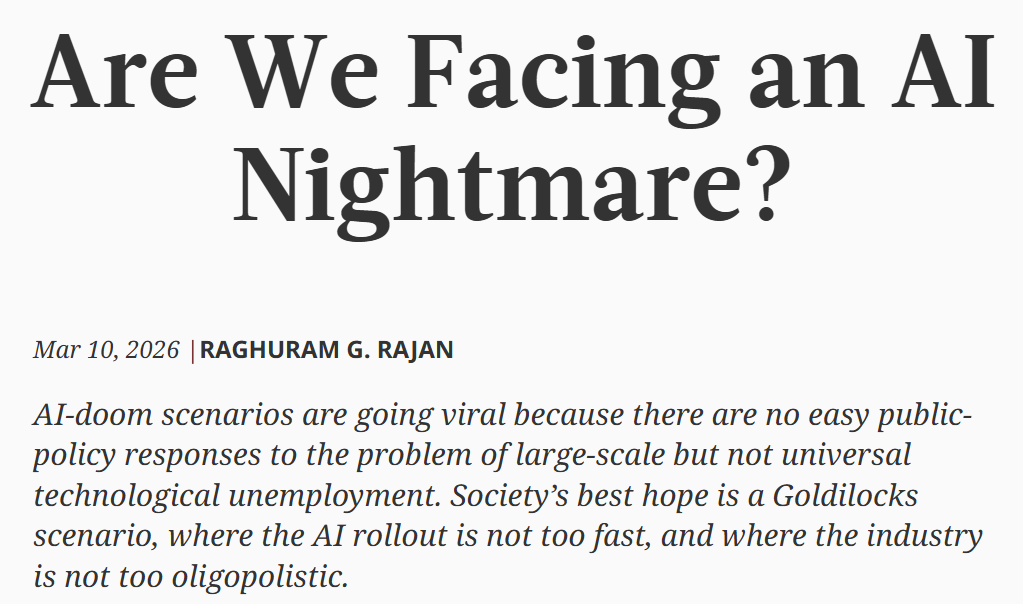
The Anchor: Raghuram Rajan, former IMF Chief Economist and former Governor of the Reserve Bank of India, published Are We Facing an AI Nightmare? in Project Syndicate on 10 March, 2026. His argument: there are no easy public-policy responses to large-scale but not universal technological unemployment. It’s rigorous, unsentimental, and stops exactly where the business decisions to act begin.
The Gap: Rajan does the macroeconomic work. The Soft Power Brief does the business case.
The Calculations
The Crossover Point: a technology-enabled transition model is already cheaper than 60 to 90 days of institutional unemployment support in most high-income displacement scenarios. [1]
The Chokepoint Map: the route to scale a solution does not require institutional permission. It already exists - for now.
The Voltage Test: most reskilling programmes are built to outlast their funding cycle, not their founding team. That is why many fail when it matters most.
The Market Opportunity: The three calculations produce a specific finding: a leader with trusted proximity to displaced workers, independence from platform employment models, and the freedom to define success on the worker's terms holds a comparative advantage no government programme and no platform can replicate. The window is 18 to 36 months.
The Problem
Raghuram Rajan’s analysis is a rigorous framing of the AI displacement problem. It maps scenarios without the false comfort of positive‑sum institutional solutions and names the failure modes precisely: government response will be slow, fragmented, and calibrated to political pain thresholds rather than worker needs, while technology platforms capture most of the transition value, further entrenching winner-takes-all outcomes. The problem is structurally hard because it does not belong to any single government, sector, or jurisdiction; it cuts across borders, industries, and professions in ways no one actor is mandated – or incentivised – to solve end‑to‑end.
The workers most at risk are not low‑wage workers who can be absorbed into service‑sector employment. They are mid‑career professionals with mortgages and specialised skills: paralegals, accountants, financial analysts, administrative coordinators, and diagnostic or decision‑support roles in medicine. These roles are being replicated by AI faster than policy can respond – and faster than the workers affected can self‑direct their way out. The data is already in the ledger: middle‑management postings have fallen sharply, professional‑services openings are at decade lows, and roughly 40% of white‑collar job seekers in 2024 did not secure a single interview. These are not projections. They are current conditions. [0]
Rajan’s core argument: there are no easy public‑policy responses to large‑scale but not universal technological unemployment. His Goldilocks scenario – AI rollout not too fast, industry not too oligopolistic – is the right frame for what institutions should be hoping for. It is not instructive for a business leader or founder deciding what to build.
The gap the analysis doesn’t reach is specific: who builds the transition architecture that serves displaced workers before platforms consolidate around credential infrastructure they own – and how it is financed without waiting for government programme cycles that will arrive too late. One design constraint any serious transition architecture must account for is the risk of double displacement. A worker reskilled into a role that is itself automated within 12 to 18 months has not been transitioned; they have been cycled. Evidence from existing transition programmes suggests that models oriented toward verifiable, transferable skills rather than role‑specific retraining are more durable against this risk. This brief shows where the gap is and what the structural requirements are; the specific design belongs to the leader with trusted access to the people the problem affects.
This is therefore not a policy question but a soft power question – for leaders with trusted proximity to the people the problem affects, independent enough to name what platforms are doing to portable worker value, and structurally positioned to move without institutional permission.
Hard power attempts to solve this problem are instructive. The US Trade Adjustment Assistance programme was repeatedly defunded, restructured, and ultimately allowed to expire in 2022. The UK’s National Retraining Scheme was announced in 2018 and quietly abandoned by 2020 without meaningful scale. Australia’s JobActive programme went through multiple reinventions, each redesigned around incoming political priorities rather than persistent worker need. These programmes did not fail for lack of commitment but because of three structural features hard power cannot overcome: they were jurisdiction‑bound in a problem that crosses borders and sectors; their definition of success was owned by funders and political cycles rather than workers; and they were designed for a political moment rather than the decade of displacement that followed. When the moment shifted, the programmes shifted with it. The workers were left where they were. [2]
Rajan’s conclusion creates the starting line for this brief: governments will move too slowly and platforms will move in their own interests, which means the decisive architecture will be built in the space in between. His analysis tells us why the system will fail displaced workers. That is where we begin – by defining, in falsifiable terms, what it would mean to succeed for a single worker caught in that transition, and then running the three calculations against that definition.
The Outcome Unit
What we are calculating towards.
Before any of the three calculations can be run, one requirement comes first: a precise, binary, verifiable definition of what solving this problem actually means. Not reskilled. Not enrolled in a programme. Not placed. Those are programme‑owned labels. They cannot be independently verified or financed against, and they let funders decide what counts as success – which is exactly when a leader’s independence is most at risk.
The Outcome Unit for AI displacement, an example:
One worker with portable, verified credentials recognised across multiple employers and platforms, in employment or self‑employment generating income above their pre‑displacement baseline, confirmed by independent income data at 18 months (via open‑banking APIs, payroll integration, or tax data, depending on jurisdiction).
Every word in that definition is load‑bearing. Portable means the credential is not locked inside a single platform’s ecosystem. Verified means independently confirmed, not self‑reported. Recognised across multiple employers means the market, not just the programme, has validated it. Income above pre‑displacement baseline means genuine recovery, not just activity. Confirmed by independent income data means the outcome is falsifiable – it either happened or it didn’t, and someone other than the programme can check.
One important boundary: this Outcome Unit applies to skills‑based roles, where competency – not statutory licence – determines employability. Paralegals, financial analysts, administrative coordinators, and many diagnostic support roles fall in this category. Statutorily licensed roles – qualified lawyers, certified public accountants signing audits, licensed medical practitioners – face legal constraints that portable credentials cannot bypass. The model described here targets the larger, faster‑growing category where the gate is a hiring filter, not a legal requirement.
That definition is what the Crossover Point calculates against, what the Chokepoint Map routes toward, and what the Voltage Test asks whether the model can produce without the founder in the room. Without it, none of the three calculations can produce a number. With it, all three become precise.
The Three Calculations
1. The Crossover Point
What it is: the moment a structural solution to a hard problem becomes cheaper than the system’s cost of doing nothing. It rests on Wright’s Law – costs fall by a predictable percentage with every doubling of cumulative production – which means the crossing point is calculable in advance, not guessed after the fact.
The calculation creates two strategic positions. If the crossover has already happened, the question is not whether to act but why the institution has not adopted the cheaper solution; the gap between what is rational and what is happening is the leader’s market position. If the crossover is still ahead but predictable, Wright’s Law gives you the trajectory and the timeline; a leader who builds the model before the crossing is not early, they are already in position when institutions finally move.
Before the crossing, every partnership comes with conditions, every funding relationship carries compromise risk, and institutional gatekeepers hold the leverage. After it, inertia runs the other way: the institution’s cheapest option is to adopt what the leader built, and the model is commercially viable by design, not as a side‑effect of mission. Hard problems stop looking like moral obligations and start looking like market positions.
Applied to AI displacement:
The legacy cost of institutional transition support – case management, in‑person training programmes, employment placement services – runs between US$8,000 and US$35,000 per worker per year in OECD systems. [3] That is the cost the state currently absorbs when a displaced worker enters extended unemployment. [3]
The current cost of AI‑assisted skills assessment, portable credential verification, and personalised reskilling pathway design is a fraction of that – and falling as platform competition increases and AI tooling becomes commodity infrastructure. Tools that once required institutional scale – labour‑market data, credential‑verification systems, skills‑matching algorithms – are increasingly available at near‑zero marginal cost on existing digital rails. [4]
The crossing point is not hypothetical. In most high‑income‑country displacement scenarios, a technology‑enabled transition model is already cheaper than 60 to 90 days of institutional unemployment support. After that crossing, the institution’s cheapest option is to fund the transition model rather than carry the cost of not doing so.
One move that brings the crossing point forward: portable credential verification on open digital‑identity rails, removing the proprietary lock‑in that currently keeps most reskilling outcomes platform‑dependent. A worker whose credentials are verified independently – not by the platform that trained them – has portable value that compounds across transitions. A worker whose credentials live inside a single platform’s ecosystem is a recurring‑revenue model for the platform, not a transition success. [5]
The commercial position at the Crossover Point: a transition model built on portable credential infrastructure, verified by independent income data, financed by the savings it produces in institutional unemployment support. That model becomes the rational choice for governments to fund not because it is mission‑aligned but because it is cheaper. That is a market position.
Incoming regulatory requirements – including AI‑Act‑style employment provisions and worker‑data‑portability frameworks under active consideration in the EU, UK, and Australia – would, if enacted, accelerate the crossing point further. The model does not depend on them. They are additional tailwind, not the engine.
2. The Chokepoint Map
What it is: A map of every point where an institutional actor can slow, veto, or tax the path from one Outcome Unit to scale. The critical distinction is between structural chokepoints – created by law, physics, or irreducible constraints – and legacy chokepoints, which persist because of habit, assumption, or incumbents who benefit from treating negotiable gates as permanent ones. In almost every hard‑problem domain, at least one chokepoint treated as fixed five years ago is now negotiable.
Applied to AI displacement:
People – access to displaced workers is a legacy chokepoint. Institutional employment services, unions, and sector‑specific bodies are the traditional routes, but not the only ones. Displaced white‑collar workers are reachable through professional networks, alumni associations, and peer communities that formed when institutional support proved inadequate. A leader with trusted proximity to those communities does not need institutional permission to reach the people the problem affects. Within this sits a harder sub‑dimension: the identity transition. Mid‑career professionals whose self‑concept is built around a role – paralegal, financial analyst, diagnostic coordinator – often need to adopt a skills‑based identity before they will engage with any programme. Trusted proximity means being able to reach workers at that moment, not just after it. Leaders who have navigated identity transitions in adjacent contexts – career pivots, sectoral shocks, organisational restructures – hold an asset no institutional programme replicates at the individual level.
Money – transition funding is shifting from structural to navigable. Government unemployment‑support funds exist, but routing through them attaches conditions that slow innovation. Outcome‑based financing – where funders are paid from the savings generated by successful transitions rather than for inputs – makes this chokepoint navigable for leaders whose Outcome Unit is precise enough to contract against. This is why the Outcome Unit must come first: imprecise outcomes cannot be outcome‑financed; precise ones can.
Data – credential verification and labour‑market intelligence is the structural chokepoint. The data that determines which skills are valued, which credentials are recognised, and which transitions endure is proprietary, held by platforms, staffing agencies, and credential bodies with strong incentives to keep it that way. This is not a legacy habit; it is actively defended. A serious transition model needs a data strategy that either routes around this chokepoint or builds open infrastructure that makes it irrelevant. [6]
That infrastructure already exists. W3C Verifiable Credentials and the 1EdTech Open Badges 3.0 standard allow credentials to be issued, held, and verified without routing through a proprietary platform. A credential built on these standards is controlled by the worker, verifiable by any employer with a compatible reader, and insulated from platform policy changes. The permissionless route is not a theory. It is a technical specification already in production use.
Legitimacy – institutional recognition of new credentials is a legacy chokepoint being defended on dissolving foundations. Most large employers still filter candidates through credential systems built for a labour market that no longer exists, even as the talent they need increasingly holds credentials those filters would exclude. The pull mechanism is talent scarcity, not institutional reform: in AI‑exposed occupations such as financial analysis, legal research, and diagnostic support, the pipeline of traditionally credentialled candidates is shrinking faster than demand. Employers who cling to legacy filters face compounding vacancies; those who update them gain early access to a growing pool of skilled, motivated, demonstrably capable workers. [7] Guild Education’s outcomes illustrate this: employers partnering with Guild to reskill existing workers see roughly 3.5‑times higher internal mobility and double the wage increases for participants, driven by retention and pipeline logic rather than altruism. [8] [9] The leader who builds transition models that produce verifiable, portable, skills‑based credentials is not waiting for institutional legitimacy; they are building the evidence base that makes it rational for institutions to update their filters.
The permissionless route: Trusted community access, plus outcome‑based financing, plus portable credential infrastructure on open digital rails produces a transition model that does not require institutional programme approval, proprietary platform partnerships, or legacy credential recognition to operate. That route exists now.
3. The Voltage Test
What it is: The test of whether a model still works when the founder is not in the room – specifically, when the government changes, the funder pivots, and the founding team moves on. Most programmes fail not because the idea is wrong but because the design was never required to answer this question. Chef‑dependency – models built around a founder’s presence, judgement, and relationships rather than replicable logic – is the structural cause. [9] Agentic AI is now a scaling architecture that lets you design for the Voltage Test from the outset, not patch for it at scale.
Applied to AI displacement:
Most reskilling programmes fail the Voltage Test the same way. They are built around the expertise of a founding team, dependent on government contract cycles or philanthropic funding, and tuned to the political moment in which they launched. When the contract ends or the moment shifts, the programme ends. Workers halfway through a transition are stranded. The credential infrastructure they were building remains proprietary to the programme that built it.
The chef‑dependent points in a workforce transition model are two: the trusted community relationships that give access to displaced workers at the moment of maximum vulnerability, and the employer relationships that make credential recognition credible. Both are solvable at the design stage. Community trust is buildable through peer facilitation rather than expert delivery; a model that trains recently transitioned workers as guides builds distributed trust infrastructure instead of relying on the founder’s relationships. Employer recognition is increasingly transferable as the evidence base for skills‑based hiring accumulates; credible evidence, not institutional mandate, is what changes behaviour.
Agentic AI shifts the calculation further. Skills assessment that once required a trained assessor can now be delivered through conversational tools at near‑zero marginal cost. Personalised reskilling pathway design that needed expensive human case management can be operationalised through AI that adapts to individual circumstances without founder oversight. A model that builds these tools into its architecture from the start is voltage‑proof in ways a model built around human expert delivery find harder to achieve.
Who is Making Ground
Organisations below are grouped by their relationship to this problem. The distinction matters: it shows what has been proven and what remains to be built.
Directly addressing this problem
Guild Education directly addressing workforce transition for incumbent workers - connects large employers to curated learning programmes, routing the employer’s existing education benefit spend toward business-aligned reskilling rather than ad hoc tuition reimbursement. In 2024, Guild enabled 60,000 programme completions across 1.4 million engaged employees, with participants recording wage increases 2 times larger than non-participants and internal career mobility 3.5 times higher. The employer pull mechanism is proven: retention and pipeline outcomes make the commercial case without requiring institutional mandate or philanthropic subsidy.
The structural limit is equally clear. Guild’s model is built inside the employer relationship - credentials are curated to the employer’s talent strategy, not portable to the open labour market. A worker whose Guild credentials are tied to their current employer’s internal mobility pathways is not holding portable value; they are holding employer-specific value. That distinction matters at the moment of displacement - which is precisely when portability is most needed. Guild demonstrates that employer-financed, outcomes-verified reskilling is commercially rational. It has not yet solved the portability problem that makes reskilling genuinely protective against displacement rather than merely useful for retention.
Structural lesson: Employer pull is real and financially quantifiable. The model that combines employer-financed outcomes with open credential infrastructure - not proprietary employer-specific pathways - is the architecture this problem needs and Guild has not yet built.
Opportunity@Work developed the STARS framework (Skilled Through Alternative Routes) to make skills-based credentials legible to employers who have historically required four-year degrees. It is working on the credential recognition chokepoint for displaced and non-traditional workers directly. The framework is designed to travel without Opportunity@Work present in every employer relationship - voltage architecture applied to the legitimacy chokepoint. Partial proof: demonstrates the chokepoint routing argument convincingly. The full Voltage Test at scale is not yet confirmed.
The hard power contrast is direct. Federal credentialling reform in the US - multiple executive orders and legislative pushes to expand skills-based hiring in the federal government - has produced limited adoption after a decade of effort. Opportunity@Work achieved measurable employer behaviour change by building the evidence base that made updating filters economically rational, rather than by mandating filter updates. Credible evidence, not compulsion, is what moves this chokepoint.
Structural lesson: The legitimacy chokepoint yields to evidence, not mandate. Soft power that builds open infrastructure changes employer behaviour faster than hard power that tries to legislate it.
Adjacent Domain, Structural Lesson Transfers
BRAC is not working on AI displacement. It has solved the voltage problem that every transition model faces. The graduation model - asset transfer, skills training, social protection, and access to financial services - is designed to run without BRAC present at every site. The financial architecture recycles participant contributions rather than depending on external grant renewal. Outcomes are verifiable by independent data rather than programme self-reporting. The structural logic transfers directly to a workforce transition context where the goal is verified income above baseline, not programme completion rates.
Structural lesson: Voltage-proof design is a founding decision, not a scaling retrofit. The model built from the outset to run without its founders is structurally different from one that adds replication mechanisms after the fact. Every major government workforce transition programme of the last two decades was built around a political moment rather than a durable architecture - and failed accordingly when the moment passed. BRAC’s model outlasts governments, funding cycles, and founding teams because it was designed to from the start.
Aravind Eye Care demonstrates the Crossover Point argument in a different hard problem domain. Aravind crossed the point at which providing eye care became cheaper than the system’s cost of preventable blindness - then built a model that delivers world-class outcomes at a fraction of the cost of comparable services, without philanthropic subsidy, without government mandate, and without its founding team present in every operating theatre.
Structural lesson: The Crossover Point is not a theory. It is an empirically demonstrated phenomenon across multiple hard problem domains. What follows it is a market position, not a mission. Government-funded eye care programmes in comparable settings have not achieved Aravind’s outcomes despite larger budgets - because the institutional incentive was programme delivery, not Outcome Unit achievement. Aravind’s independence from that incentive structure is what allowed it to optimise for the crossing point rather than the budget cycle.
The Gap
No organisation has yet assembled a fully voltage-proof, outcome-financed workforce transition model built on portable credential infrastructure, serving displaced white-collar workers in the specific occupational categories most affected by AI displacement, at the scale the problem requires. The structural lessons exist across the organisations above. The components exist. The architecture that combines them into a self-funding model - one that runs without institutional contract renewal, without founder presence, and without routing through the platforms that currently own the credential infrastructure - has not yet been built.
That gap is filled by soft power, not by budget or institutional mandate. Specifically: trusted proximity to displaced workers at the moment of maximum vulnerability, structural independence from the platform employment models capturing the transition, and the freedom to define success on the worker’s terms rather than the funder’s. Rather than being sector-specific, those characteristics are held by leaders who developed them in any context where independence from a more powerful actor determined what was possible.
The Market Opportunity
The window for building the right transition architecture is 18 to 36 months. Two consolidation trends are closing it at the same time. First, platform M&A: in December 2025, Coursera acquired Udemy in a US$2.5 billion deal, combining two of the world’s largest workforce‑credential ecosystems into a single platform serving 270 million learners. Second, LLM providers – OpenAI, Google, Microsoft – are building agentic career coaching directly into operating systems and productivity suites. When AI career guidance becomes ambient infrastructure rather than a standalone product, the interface through which displaced workers navigate transition will be owned by the same firms whose AI caused the displacement. Both trends narrow the window for independent credential infrastructure; 18 to 36 months is a live estimate, and the real window may be shorter. [10]
The default trajectory is already visible. Reskilling programmes multiply. Credentials proliferate on proprietary platforms. Workers complete programmes and discover their new credentials are legible only within the ecosystem of the platform that issued them. The transition succeeds by the platform’s definition of success – continued platform dependency – and fails by the worker’s, which is portable value and genuine income recovery. That trajectory requires no decision. It is what happens when the leaders who could build something different are still routing through the gatekeepers the permissionless route was designed to bypass.
The commercial position available to a leader who moves now is specific. A transition model built on the Outcome Unit defined above – portable credentials, independent income verification, 18‑month baseline – is contractable. It can be outcome‑financed against the savings it produces in institutional unemployment support. It does not require philanthropic subsidy. It does not require government programme approval. After the Crossover Point, the institution’s cheapest option is to fund it. That is not advocacy. That is a market position with a closing window.
The architecture that fills this gap does not require institutional permission to build. It requires proximity, independence, and a precise enough Outcome Unit to finance against. If you hold the first two, the third is where the conversation starts. A three‑way distinction helps: a leader with trusted proximity but no structural independence from platform employment models is a platform partner – their access serves the platform’s interests, not the worker’s. A leader with structural independence but no trusted proximity to displaced workers is a think tank – their analysis is credible but not deployable at the moment the problem is actually happening. A leader who holds both is the decisive architecture builder this brief is describing. That position is rare. It is not credential‑dependent, sector‑specific, or budget‑constrained. It is structural.
The window is the same for all of us. What we do with it is the decision this series is built around. The gap is mapped. What you bring to it is the next key question.
The Soft Power Assessment maps what you’re holding. If the result suggests this is your problem to move, that’s where I work - mapping soft power against hard problems like this one and finding where the leverage actually sits.
This problem is one of twelve. By Edition 12 you’ll have a clear picture of where your leverage is highest.
Sources and Notes
[0] The problem: scale and trajectory: The IMF estimates roughly 40% of jobs globally face meaningful AI exposure, rising to approximately 60% in high‑income economies. The WEF Future of Jobs Report 2025 (building on the 2023–2025 cycle) projects 92 million roles displaced by 2030 alongside 170 million new ones created, a net gain of 78 million. The net figure masks a distributional problem: the jobs lost and the jobs created are not in the same sectors, geographies, or skill levels. Middle‑management job postings dropped more than 40% between April 2022 and October 2024 (Deloitte). US job openings in professional services hit their lowest level since 2013 in January 2025, a 20% year‑on‑year fall (BLS JOLTS). Approximately 40% of white‑collar job seekers in 2024 failed to secure a single interview (American Staffing Association). In low‑ and middle‑income countries, direct generative‑AI displacement risk is currently lower (ILO estimates 0.4% of jobs vs 5.5% in high‑income countries), but automation risk in manufacturing, logistics, and routine services affects a far larger share of the workforce. Sources: IMF, Gen‑AI: Artificial Intelligence and the Future of Work (2024); WEF, Future of Jobs Report 2025; Deloitte (2024); BLS (January 2025); American Staffing Association (2024); ILO, Generative AI and Jobs (2023).
[1] Crossover Point cost range: US$8,000-US$35,000 per participant per year reflects OECD public‑spending data on labour‑market programmes. OECD training spend for unemployed workers averaged 0.1% of GDP in 2023, a 30% fall since 2010. The 60-90 day crossover estimate is derived by amortising the US$8,000-US$35,000 annual OECD carry cost against the $500-$1,500 per-user licensing costs of enterprise reskilling SaaS, assuming a successful transition within one fiscal quarter. Sources: OECD/TUAC, Time to Activate Labour Market Policies (2025); OECD ALMP dataset; OECD Skills Outlook.
[2] Hard‑power workforce transition failures: US TAA lapsed July 2022, serving 40,000-60,000 workers annually in final years. The UK National Retraining Scheme, examined in NAO reporting on the adult skills system, was wound down by 2020 without reaching scale. Australia’s JobActive was redesigned four times 2003–2022; an ACOSS review found compliance was prioritised over outcomes. Sources: US Congressional Research Service; UK National Audit Office; Australian Centre for Social Policy / UNSW Social Policy Research Centre.
[3] Cost of institutional transition support: Same range as note [1]. US Trade Adjustment Assistance and the UK Flexible Support Fund sit toward the lower end; J‑PAL‑evaluated intensive programmes toward the upper end. Source: OECD Employment Outlook.
[4] Declining cost of AI‑assisted skills infrastructure: AI assessment platforms (Workera, iMocha, HackerRank) now operate as enterprise SaaS with falling per‑assessment costs. The technical foundation for portable credentials is W3C Verifiable Credentials and Self‑Sovereign Identity - open standards allowing credentials to be issued, held, and verified without a proprietary intermediary. 1EdTech Open Badges 3.0 implements these standards and is widely adopted. Sources: platform documentation (2025); 1EdTech Digital Credentials Summit 2025; W3C VC Data Model 2.0 (2024).
[5] Portable credentials and platform lock‑in: Around 44% of Fortune 500 firms offer internal micro‑badge pathways tied to external providers. The 1EdTech Wellspring Initiative exists specifically to prevent credential lock‑in via open standards. Source: EdTech Breakthrough, Credentialing in the AI Economy (2025).
[6] The data chokepoint: Only about 15% of HR professionals can currently act on skills credentials in hiring decisions. Source: 1EdTech / HolonIQ Digital Credentials Summit 2025 reporting and HolonIQ 2025 Global Learning Outlook.
[7] Shifting employer credential preferences: 74% of employers in 2025 preferred verified digital skills credentials for AI‑related roles over degrees alone; job postings recognising verifiable AI certifications grew ~31% between 2024 and 2025. Sources: WEF Future of Jobs; LinkedIn Economic Graph / Workforce Report.
[8] Guild Education outcomes data: For 2024, Guild Education reports learners saw wage increases roughly 2× higher than non‑participants, were 3.5× more likely to move internally, with 60,000 programme completions and 1.4 million engaged. Revenue model depends on employer partnerships, not open worker‑owned credentials. Sources: Guild press release “Guild Has a Banner 2024” (Jan 2025); Sacra equity research on Guild (Feb 2026).
[9] Chef‑dependency and the Voltage Test: Draws on John List, The Voltage Effect (Currency, 2022) and University of Chicago Crime and Education Lab research on scale and ‘voltage drop’.
[10] The 18 to 36 month window: Strategic estimate, not a formal forecast, based on two consolidation trends: platform M&A (Coursera–Udemy, US$2.5bn, December 2025; 300+ EdTech deals in 2024) and LLM vertical integration (OpenAI, Google, Microsoft embedding career coaching into OS and productivity suites). Sources: ALM Corp Coursera–Udemy analysis; HolonIQ EdTech M&A data.