

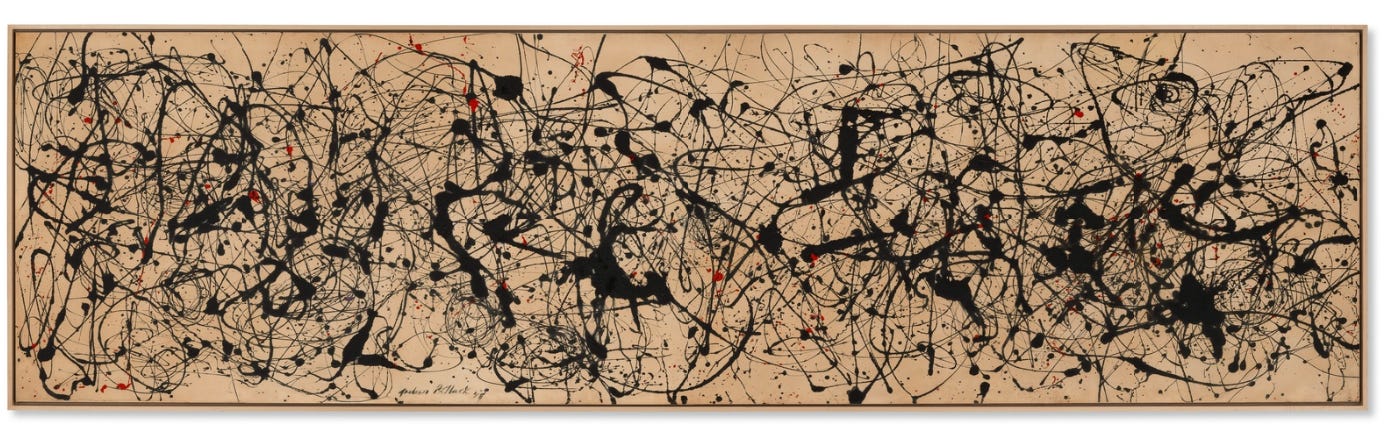
Number 7A, 1948 is an 11-foot-wide canvas made from poured, dripped, and pooled enamel paint. In May this year, it set a new auction record for a work by Jackson Pollock when it sold for US$181.2 million at Christie’s New York.

The sale took place at a time when economic contraction, budget constraint, and financial pressure continue to shape boardrooms, meeting rooms, and living rooms around the world.
The contrast is stark. It points to two tracks now running through the global economy.
On one track are delayed investments, constrained budgets, cost reductions, and caution. On the other are concentrated capital, conviction, and significant upside for assets, companies, and opportunities that buyers believe will deliver returns.
Value is being created and captured unevenly.
As we edge closer to 2027, the opportunity is for leaders to update their calculations about where value is being created - and what it will take to capture it.
We see this in organisations trying to make decisions in conditions their existing models were not built to describe. A market is assessed using last year’s demand data. A problem is sized using old cost models. A business case is built around what comparable assets sold for at another time, under different conditions.
Exponential technology, particularly AI, is often added as a driver of growth, without testing whether the underlying business model is viable for the future.
The inputs may be familiar and credible. Yet they may describe the world as it was - or as we hope it will be - rather than the conditions in which the decision will need to work.
The world changes faster than many of our calculations do.
The value of what already exists - and of what could be created next - increasingly cannot be taken from historical numbers alone. It must be assessed against the conditions forming now: the cost of leaving a problem unresolved; the demand a solution could unlock; the capabilities and alliances needed to deliver it; and the ability to earn trust across a complex system.
This requires three updated calculations. They take little time and no money to update.
The first is the problem calculation: what is the actual and rising cost of leaving this problem unresolved? This tells us whether the problem is sufficiently large, persistent, and consequential to create a pool of value. When the cost of leaving the problem unresolved is rising while the cost of solving it is falling - and few others are operating in the space - the crossover point may be approaching. That is often a moment to act.
The second is the position calculation: where can we create a differentiated role in solving it, and would that role still hold if the people who built it moved on, or the conditions that created it changed? This identifies how a company, investor, or institution can create and retain value - not just participate in an attractive market, or play a passive role within it.
The third is the power calculation: whose trust, support, funding, permission, or partnership is needed for this to reach its potential? Here, soft power becomes practical. It determines whether an attractive idea can secure the relationships and legitimacy needed to become a viable market position in the world. The goal is not to avoid external support. It is to build a position that can create and sustain value beyond it.
Pollock’s sale shows the factors that can result in an exceptional price in the world today: scarcity, historical significance, buyer conviction, and the belief that it is one of the most important works of art in the world.
Few organisations can command that kind of price or demand. Yet organisations can update how they see value being created and captured by asking a different question:
What makes this problem, capability, or market position compelling enough that others will pay to access it, partner to advance it, or allocate capital behind it?
Further Reading
The Soft Power Index is a practical tool for assessing the relationships, trust, legitimacy, and influence needed to turn an idea into an operating position in the world. It maps organisations working on some of the world’s hardest problems.
It is designed for ideas with the potential to positively affect millions - or billions - of people. These are some of the largest and least adequately served markets of our time.
It supports the third calculation in this article: whose trust, support, funding, permission or partnership is needed for an opportunity to reach its potential?

Do the maths: Is there a market position from solving this hard problem?

Some hard problems remain hard because the cost of solving them is too high to act on. Others remain hard because no one can agree on what leaving them unsolved is costing. Carbon has been the second kind for most of the last two decades, which is why it has largely been treated as a compliance obligation rather than a market position. The argument has long been about the number. That argument now has a peer‑reviewed anchor. The argument becomes about who will find the market position.
The Burden of Knowing Better

“We’ve always done it that way.” This is possibly the most dangerous phrase to be spoken in an organisation today.
Beyond a Money or Mandate Starting Point
Leaders who care about solving a hard problem that affects millions or billions of people often start with the same questions:
Who has the money?
Who has the mandate?
How do we get close to them?
There’s an alternative:
Begin with a calculation that tells you whether the economics support you building a commercially viable solution.
Golden Age or Depressed Decade? Breaking down the World Bank Global Economic Prospects
It can feel as if the lights are going out across the global economy. Outside big tech and winner-takes-all platforms, that is not the whole picture. New market positions are forming inside the largest, hardest, longest-running problems on earth - and the economics of holding those positions have shifted decisively in the past three years. This article …