

The Year of the Fire Horse offers a metaphor. In Chinese astrology, the Fire Horse appears only once every 60 years and is associated with speed, momentum, and decisive action.
If you’re a leader working on hard, system‑scale challenges, this is one of those years where the symbolism lines up with the data: beyond zodiac predictions, the combination of geopolitical tension, climate shocks, and rapid AI deployment means 2026 rewards clarity and conviction more than caution and delay. We know that shared problems crossing borders - climate risk, pandemics, ageing populations, and energy transition - will not slow down to match political hesitation.
Below is a framework for using soft power as leaders to reposition China from a challenge often framed as a hard problem, particularly in the West, into a potential solution partner. China is already accelerating outcomes in biotech, and there are lessons here for other industries working on hard problems.
The Fire Horse message: speed through synergy
The New Year idiom Mǎ dào chéng gōng - success upon the arrival of the horse - signals swift progress. This is relevant in 2026, as the scale and pace required to address global challenges is stronger than the capacity of any single nation operating alone.
The message shifts to:
“In the Year of the Fire Horse, the hardest problems are moving faster than any one country. Leaders who keep pace are shifting from containment to contribution\. By integrating Chinese innovation into high‑standards global ecosystems, progress accelerates in ways separation cannot deliver.”
It’s about speed. Yet, it is not speed through exclusion or extraction. It is speed through coordination.
Strategic win‑win: from biotech and AI to system solutions
A good example is Biotech. In 2026, we see how hard power responses relies on export controls and data walls. A soft power response focuses on shaping shared outcomes.
Instead of full‑scale mergers, which trigger more intense security and political scrutiny, Western pharma giants are increasingly using licensing deals to integrate Chinese innovation into their pipelines.
The AstraZeneca-CSPC alliance:
Announced on 30 January 2026, AstraZeneca agreed to a strategic R&D and licensing deal with China’s CSPC Pharmaceutical Group for a portfolio of long‑acting GLP‑1 obesity and diabetes drug candidates. It has a total potential value of up to US$18.5 billion. These candidates and platforms draw on CSPC’s proprietary AI‑based peptide discovery and sustained‑release (once‑monthly) delivery technologies.
The strategy:
AstraZeneca is licensing access to CSPC’s molecules, AI‑driven platforms, and long‑acting delivery technology. This lets AstraZeneca bring next‑generation weight‑loss and metabolic drugs to global markets faster and at lower development risk than building everything in‑house, while keeping IP structures modular and agile.
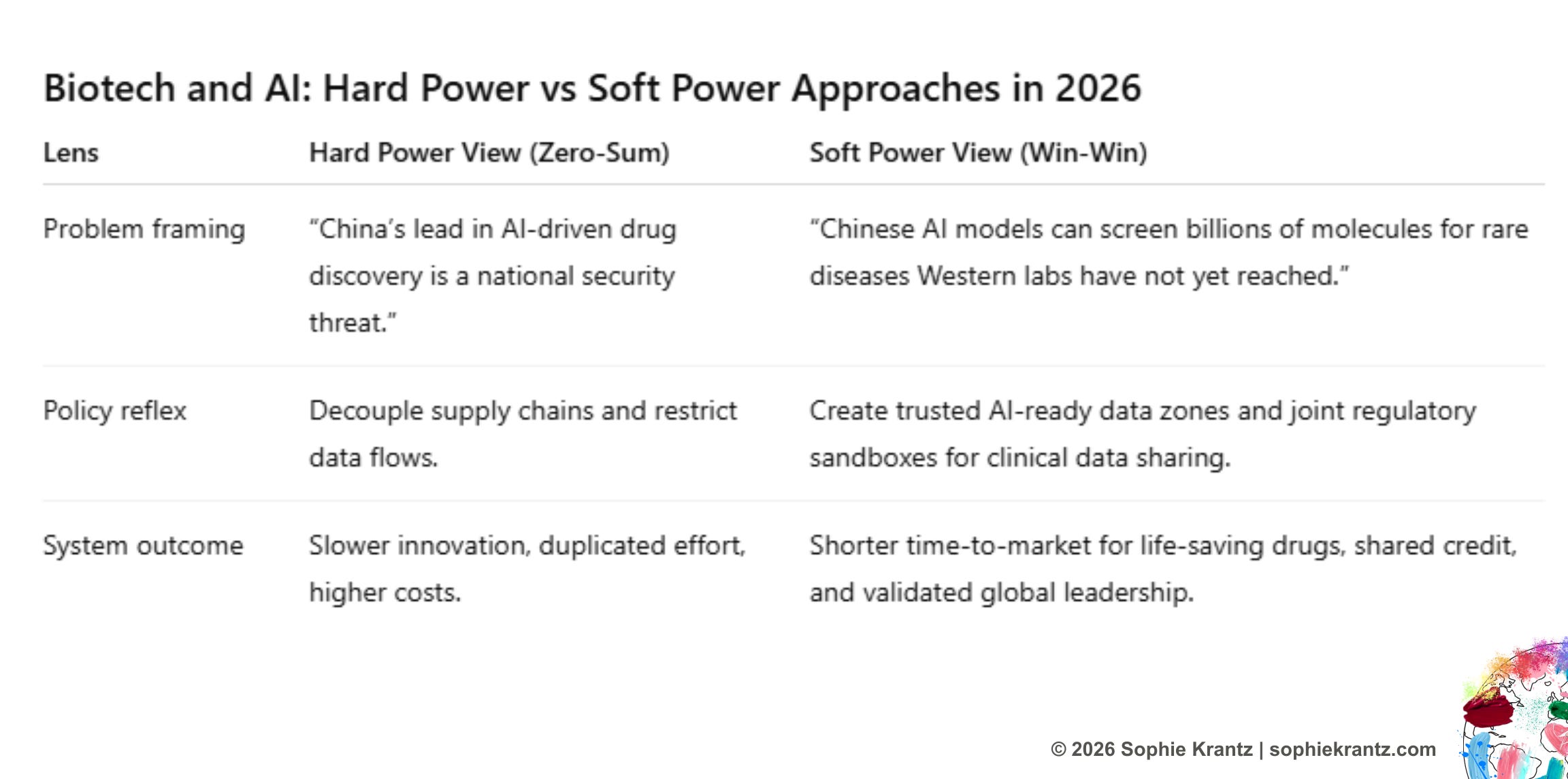
China now accounts for a significant share of global drugs in development and is becoming a central hub for AI‑enabled, data‑intensive research and development. Engagement in biotech is a leverage strategy.
The same logic extends beyond biotech to grid‑scale storage and clean energy deployment, critical minerals processing, advanced manufacturing, digital infrastructure, and resilient food systems. A soft power approach makes participation in high‑standards global collaboration attractive and economically rational. Over time, alignment emerges through incentives and shared results rather than coercion.
A Fire Horse framework for leaders
If leaders want to include China in solving hard problems this year, three Fire Horse principles apply.
Gallop together (scale)
China’s unified market and 1.4‑billion‑person population function as a large‑scale testbed. If a model works at China scale - in digital health, aged‑care systems, grid management, emissions reduction, or urban mobility - it has already been stress‑tested against complexity: dense megacities, diverse regions, and tens or hundreds of millions of users. That does not guarantee a simple copy‑paste elsewhere, however it means the underlying approach, data infrastructure, and operating logic are far more likely to be adapted and localised for other marketsHarness the vitality (speed)
China contributes a rapidly expanding share of the global innovation pipeline - in drugs, clean tech, advanced materials, and AI‑enabled design. A soft power leader frames this capacity as acceleration for shared outcomes, not as a zero‑sum threat to be ring‑fenced.Temper the flame (stability)
Speed without governance creates volatility. Soft power leadership introduces regulatory discipline, ethical guardrails for AI and data, and frameworks that ensure national interests are advanced through global public goods: healthier populations, more resilient supply chains, and a faster, fairer energy transition.
Galloping into the Future
In 2026, effective soft power is measured by how quickly it turns shared problems into shared solutions – by making progress faster, more accessible, and less contained within any single system.
If, in a few years’ time, a leader can say, This treatment reached patients earlier because AI developed in one system was integrated with clinical data and manufacturing capacity in another, or This grid remained stable in a heatwave because storage technology scaled across markets, that is soft power operating at strategic depth.
That is the Fire Horse interpretation of leadership: moving with pace while maintaining alignment, and converting hard geopolitical friction into structured collaboration around shared global challenges.
Soft Power: What is it? Does it matter in 2026?

Soft power is the trust that makes other people’s effort, capital, and decisions align with yours without you having to pay or force them.
Hard Problems: What are they? What's the upside to solving them in 2026?
Hard problems are shared global challenges - affecting millions or billions of people - where the risks and the rewards are entangled across borders, and no single actor has the mandate, money, or technology to solve them alone.
Soft Power: Weak or Strategic Weapon?
Soft power is the trust and influence you can deploy; hard problems are the shared challenges where that effort can unlock outsized strategic and commercial gains.
In this environment, influence is a perishable asset. Using it to move a shared problem goes beyond doing good - it is a disciplined choice to capture the orchestrator’s premium and build resilience in an increasingly high‑friction world.
Middle Power, Bigger Game

For most of the post-war era, Australia has played a relatively small economic role: a dependable supplier of raw commodities, a close US ally, and a price-taker in global markets rather than a rule-shaper. Trade and foreign policy were often framed as a choice between loyalty to Washington and market access in Beijing. Canberra leaned heavily on the alliance, accepting that decisions taken elsewhere would define prices, standards, and technologies. Critical minerals have disrupted that pattern, forcing Australia to move from a ‘quarry at the edge’ to a strategic architect within the system.